
Someone three blocks away just searched for exactly what you sell. They got three businesses in a map pack, picked one, and called. You weren’t in it.
That’s the whole problem local SEO solves. And unlike national organic rankings — where a new site fights every competitor on the internet — local search is a fight you can realistically win, because your competition is limited to businesses in your area.
Here’s how to do local SEO for a small business, step by step, and where to stop doing it by hand.
What local SEO is and who needs it
Local SEO is the work of ranking in geographically-triggered search results: the map pack (those three business listings with a map above the regular results), Google Maps itself, and location-flavored organic results.
It runs on a partly separate ranking system from standard SEO. Google weighs three things heavily for local: relevance (does your business match the query), distance (how close are you to the searcher), and prominence (how well known and well reviewed are you).
You need local SEO if you:
- Serve customers at a physical location — a shop, clinic, restaurant, salon
- Travel to customers within a service area — trades, mobile services, contractors
- Have multiple locations
- Get asked “do you cover [suburb]?” regularly
You don’t need it if you’re purely online with no geographic service area. In that case, work through our new website SEO guide instead and skip this one.
The payoff is immediacy. Google’s own consumer research found that 76% of people who search on their smartphone for something nearby visit a business within a day, and 28% of those searches result in a purchase (Think with Google). Local searchers aren’t browsing. They’re buying.
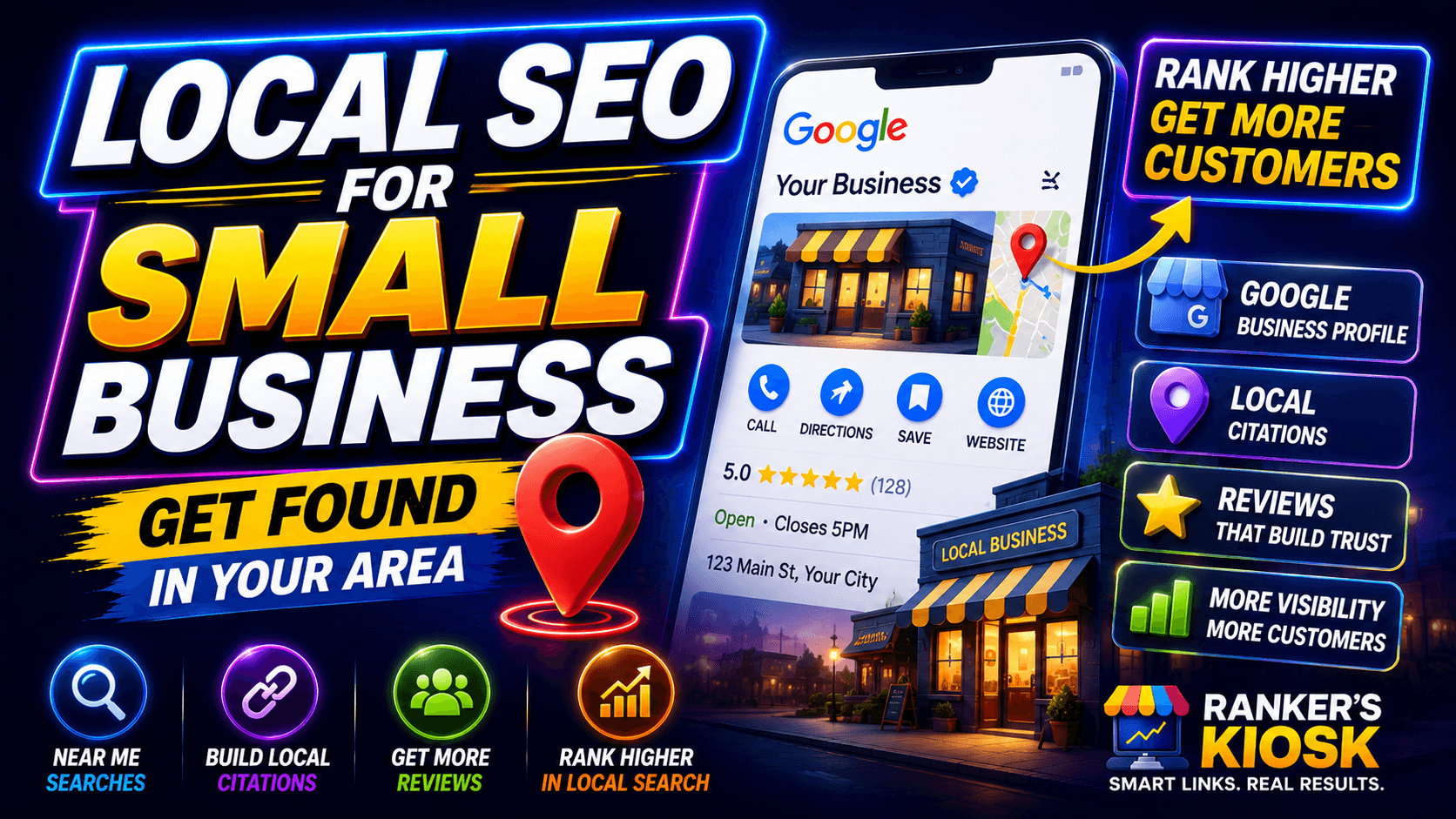
Google Business Profile: your #1 local asset
If you do nothing else on this page, do this. Whitespark’s annual ranking factors survey puts Google Business Profile signals at 32% of local pack ranking influence — the largest single category (Whitespark).
Google’s own numbers back the effort: customers are 2.7 times more likely to consider a business reputable with a complete profile, 70% more likely to visit, and 50% more likely to consider purchasing (Google Business Profile Help).
Claim and verify it first. Search your business name on Google. If a profile exists, claim it. If not, create one at google.com/business. Verification is usually by postcard, phone, or video.
Then complete every single field:
- Exact business name — your real trading name, no keyword stuffing. “Dallas Plumbing Co” is fine; “Dallas Plumbing Co | Best Emergency Plumber Dallas” risks suspension.
- Primary category — the single most important field after the name. Pick the most specific accurate one, then add secondary categories.
- Address or service area — one or the other. Service-area businesses that don’t serve customers at their address should hide the address.
- Hours, including holiday hours — outdated hours are a top source of bad reviews.
- Phone number — a local number outperforms a toll-free one.
- Website link — point it at the most relevant page, not always the homepage.
- Services and products — list them individually with descriptions.
- Photos — real ones, of your actual premises, team, and work. Add new ones regularly.
- Q&A — seed it yourself with the questions customers actually ask.
- Posts — publish updates, offers, and events. It signals an active business.
A striking gap worth exploiting: BrightLocal research found just 35% of small businesses have a Google Business Profile at all (BrightLocal). Simply doing this properly puts you ahead of most of your competitors.
Local citations and business directories
A citation is any online mention of your business name, address, and phone number — directories, review sites, industry listings, chambers of commerce. Google uses them to corroborate that your business is real and located where you claim.
NAP consistency is the entire game. Your Name, Address, and Phone must be formatted identically everywhere. “Suite 4” on one listing and “Ste. 4” on another creates ambiguity, and ambiguity dilutes the signal. Pick one canonical format — matching your Google Business Profile exactly — and use it without exception.
Where to build them:
- Core aggregators and majors — Google, Bing Places, Apple Business Connect, Yelp, Facebook
- Industry-specific directories — Healthgrades, Angi, Avvo, TripAdvisor, whatever your vertical uses
- Local directories — chamber of commerce, city business listings, regional guides
Also audit for duplicates. An old listing with a previous address or disconnected number actively works against you.
Here’s where DIY gets grim. Each submission is a form, an account, an email verification, and often a wait. Fifty directories is a full day of clerical work, plus ongoing maintenance whenever a detail changes.
That’s a solved problem — our citation building service submits consistently across the directories that actually carry weight and handles the verification chase. Build your core citation set to get the base layer down in one pass.
Reviews and how they affect local rankings
Reviews are a ranking factor and a conversion factor simultaneously, which makes them the highest-leverage thing on this page after your Business Profile.
BrightLocal’s 2026 Local Consumer Review Survey found:
- 97% of consumers read reviews for local businesses (BrightLocal)
- 47% won’t use a business with fewer than 20 reviews — and only 9% would use one with five or fewer
- 31% will only use a business rated 4.5 stars or higher, up sharply from 17% the previous year
- 74% only care about reviews written in the last three months
- 85% are more likely to use a business after reading positive reviews; negative reviews deter 77%
Read those together and the strategy writes itself: you need volume, you need quality, and you need recency. A 4.9-star rating built from thirty reviews two years ago is worth less than a 4.6 with reviews from last week.
How to get them: ask every satisfied customer, immediately after the job while goodwill is highest. Send a direct link to your review form. Make it one tap. Build the ask into your invoice or follow-up message so it happens automatically rather than when you remember.
And respond to all of them. 80% of consumers say they’re more likely to use a business that responds to all its reviews, 42% are unlikely to use one that never replies, and 89% expect a response (BrightLocal). One caveat worth heeding: templated replies put off 50% of consumers. Write real responses.
On-page local signals
Your website needs to reinforce what your Business Profile claims.
- Location pages — one substantial page per service area, with genuinely distinct content. Not fifty near-identical pages with the suburb swapped; that’s a doorway page pattern Google explicitly targets (Google Search Central).
- NAP in your footer — visible sitewide, matching your citations exactly.
- LocalBusiness schema markup — structured data telling search engines your name, address, phone, hours, and geo coordinates in machine-readable form. Google’s local business structured data documentation covers the format.
- Embedded Google Map on your contact page.
- Location-aware title tags — “Emergency Plumber in North Dallas | Same-Day Callouts” beats “Services.”
Getting these right is standard on-page work with a geographic slant — our on-page SEO checklist covers the underlying mechanics.
Social bookmarking and local links
Local link building is simpler than national link building because the opportunities are physical and nearby:
- Sponsor a local sports team, event, or charity — sponsorship pages link out
- Join your chamber of commerce and industry associations
- Get covered by local news and community blogs
- Partner with complementary local businesses and cross-reference each other
Underneath that, social bookmarking gives you cheap profile breadth and helps new location pages get discovered and indexed faster. Social bookmarking packages handle the volume — add a bookmarking layer.
For the heavier authority work, our backlinks guide covers the methods that move competitive local terms.
Doing local SEO at scale — the done-for-you route
Let’s be straight about the workload. Claiming and optimizing one Google Business Profile is an afternoon — genuinely worth doing yourself, because nobody knows your business better. Fine.
Then comes the recurring part: fifty-plus directory submissions with identical formatting, duplicate cleanup, monthly Business Profile posts, chasing reviews after every job, responding to all of them within a week, and building local links. That’s not a project. That’s a permanent part-time role, and it’s the part small business owners abandon first.
Which is exactly why the businesses that stay in the map pack are usually the ones that stopped doing it manually:
- Full citation building and cleanup — consistent NAP across every directory that matters, duplicates removed.
- Ongoing citation maintenance — new directories added monthly so your footprint keeps growing.
- Social bookmarking bundles — breadth beneath your core listings.
- Complete SEO packages — citations, on-page, and authority links handled together when you’d rather buy the outcome than the components.
One more reason to move now. BrightLocal found that use of ChatGPT and other generative AI tools for local business recommendations jumped from 6% to 45% in a single year, making it the third most popular source of recommendations (BrightLocal). AI assistants build those recommendations from the same signals — your profile, your citations, your reviews. The businesses with a clean, consistent, well-reviewed footprint today are the ones getting recommended by AI tomorrow. Our AI search optimization guide covers that shift in full.
Frequently Asked Questions
What is local SEO and how does it work?
Local SEO is the practice of optimizing your online presence to appear in geographically-triggered searches — the map pack, Google Maps, and “near me” results. Google ranks local results on relevance, distance from the searcher, and prominence, which it assesses through your Google Business Profile, citations, reviews, and website signals.
Why is local SEO important for small business?
Because local searches convert unusually fast. Google’s research found 76% of people who search for something nearby on a smartphone visit a business within a day, and 28% of those searches lead to a purchase (Think with Google). It’s also winnable — you compete against businesses in your area, not the entire internet.
How much does local SEO cost?
It varies widely by market and scope. The DIY foundation — claiming your Business Profile, basic citations, asking for reviews — costs only your time. Paid services typically start with one-off citation packages and scale into monthly retainers covering citations, content, and link building. Compare it against the value of one additional customer per month; for most service businesses the math is favorable quickly.
How do I improve my local SEO rankings?
In priority order: complete and actively maintain your Google Business Profile, build consistent citations with identical NAP formatting, generate a steady flow of recent reviews and respond to all of them, create genuinely distinct location pages with LocalBusiness schema, and build local links. Consistency over months matters more than any single optimization.
How long does local SEO take to work?
Google Business Profile optimizations can move map pack rankings within two to six weeks — much faster than national organic SEO. Citations take one to three months to be crawled and factored in. Review velocity compounds continuously. Most small businesses see measurable local improvement within three months of doing it properly.
Do I need a physical address for local SEO?
No, but you need a defined service area. Service-area businesses — trades, mobile services — can create a Google Business Profile using a service area instead of a displayed address. Google requires a real address during verification, but you can hide it from public display. Businesses that serve customers at their premises should show the address.
What are local citations and do they still matter?
Citations are online mentions of your business name, address, and phone number on directories and listing sites. They still matter as corroborating evidence that your business is real and located where you claim. Their direct ranking weight has declined relative to reviews and Business Profile completeness, but inconsistent or missing citations actively hurt — which makes them a hygiene requirement rather than a growth lever.