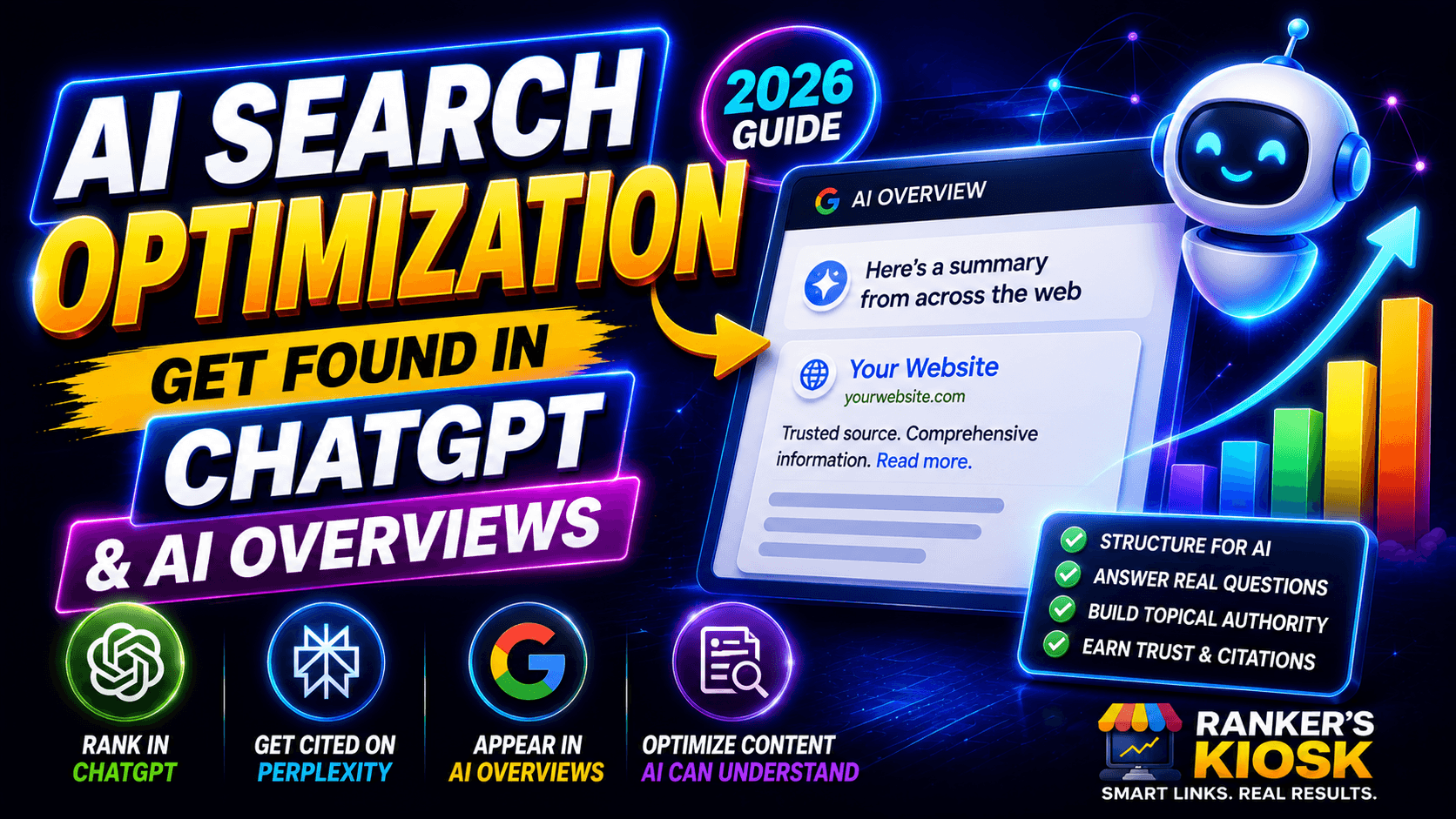

Your customers have started asking ChatGPT the questions they used to type into Google. And ChatGPT is answering — by naming a handful of businesses, none of which are yours.
That’s the AI search problem in one sentence. Ranking on page one still matters, but page one is no longer the only place the decision gets made. AI search optimization is the work of getting your site into the answers themselves.
Here’s what’s actually changed, how these engines choose who to cite, and what to do about it.
Why AI search changes the game
The scale arrived faster than most site owners noticed. Google’s AI Overviews now reach 2 billion monthly users, and AI Mode passed 100 million users in the US and India alone (Google/Alphabet Q2 2025). ChatGPT referral traffic grew 206% year over year between January 2025 and January 2026 (Semrush).
The impact on clicks is measurable and unkind. Pew Research installed browser trackers on 900+ US adults and found that when a Google AI summary appears, users click a traditional search result 8% of the time — versus 15% when no summary appears. They click a link inside the AI summary itself just 1% of the time, and they end the browsing session entirely on 26% of pages with an AI summary versus 16% without (Pew Research Center).
Two things follow.
First, keep the scale honest. Google still sends 345 times more traffic than ChatGPT, Gemini and Perplexity combined (Ahrefs). Anyone telling you to abandon SEO for “GEO” is selling something. AI search is an addition.
Second, the traffic you do get is worth more. Semrush’s clickstream analysis found the average AI search visitor is worth 4.4x more than a traditional organic search visitor on conversion measures (Semrush). ChatGPT users click out to external sites 1.4 times per visit versus 0.6 for Google users (Momentic), and Adobe found AI-referred retail visits have a 27% lower bounce rate with 38% longer sessions (Adobe).
Fewer visitors, better visitors. That’s the trade.
There’s one more number worth internalizing if you run a business site: 50% of all links ChatGPT cites point to business and service websites (Semrush). This isn’t a game only publishers can play.
How AI engines pick which sources to cite
Different engines, broadly similar logic. Three things drive citation.
Authority and corroboration. These systems favor sources that other trusted sources already reference. Concentration is extreme — an analysis of 36 million AI Overviews found YouTube accounts for roughly 23.3% of all citations and Wikipedia for 18.4% (Surfer). You’re not beating Wikipedia. You’re competing for the long tail of specific, specialized queries where a real business with real expertise is the better answer.
Extractable structure. An AI engine has to lift a clean, self-contained answer out of your page. Content that buries its answer under 400 words of preamble doesn’t get quoted. Content that answers in the first sentence does.
Freshness. Ahrefs analyzed nearly 17 million citations and found AI-cited content is 25.7% fresher on average than pages ranking in standard organic results (Ahrefs). Stale pages get passed over.
Volume of sources varies by platform: ChatGPT cites an average of 15 sources per response while Gemini cites around three (Semrush AI Visibility Index 2026). More citation slots means more opportunity — ChatGPT is the more winnable target for a smaller site, which is fitting given it drives 77.97% of all AI referral traffic globally, with Perplexity at 15.10% (SE Ranking).
How to optimize for AI search yourself
Answer-first content and clear structure
This is the highest-leverage change and it costs you nothing but discipline.
- Lead with the answer. Under every H2 that poses a question, answer it in the first one to three sentences. Then explain. This is the single most reliable way to get quoted.
- Write self-contained passages. Each section should make sense lifted out of the page, because that’s exactly what happens to it.
- Use question-shaped headings. “How much does local SEO cost?” gets matched to a prompt. “Pricing” does not.
- Add real FAQ sections with direct, complete answers.
- Front-load the important material. Roughly 70% of users read only the first third of an AI Overview (Growth Memo) — and the same positional bias applies to what gets extracted from your page.
- Keep it current. Put a visible update date on the page and actually update it, given the 25.7% freshness gap (Ahrefs).
Schema and entity clarity
Structured data doesn’t force a citation, but it removes ambiguity about what your page contains and what your business is.
Worth implementing: Organization schema on your homepage, FAQPage on pages with FAQ sections, Article with author and date on your posts, LocalBusiness if you serve an area, and Product on commercial pages. Google’s structured data documentation covers the formats.
Beyond markup, be consistent about entity clarity — describe your business the same way everywhere, keep an About page that plainly states who you are and what you do, and name your authors with real credentials. AI systems build an internal picture of your brand from every mention across the web, and contradictions weaken it.
Get mentioned on sites AI trusts
Here’s the part that separates sites that get cited from sites that don’t.
AI engines don’t discover you in isolation. They synthesize from sources they already trust. If your business is mentioned, reviewed, quoted, and linked across relevant publications, review platforms and industry sites, you show up inside the answer. If your website is the only place on the internet that mentions your business, you don’t exist to these systems.
Practically, that means:
- Getting published or quoted on established industry sites
- Being referenced inside existing, well-ranked articles on your topic
- Maintaining active, complete profiles on relevant review and listing platforms
- Building consistent brand mentions across the web, not only backlinks
This is where DIY runs into the same wall as traditional link building, only harder — you need placements across many trusted domains, and you need them to keep coming. We’ll come back to this.
Reviews, citations and brand signals
For local and service businesses, this overlaps directly with local SEO — and the shift is already visible in consumer behavior. BrightLocal found use of ChatGPT and other generative AI tools for local business recommendations jumped from 6% to 45% in a single year, making it the third most popular source of business recommendations (BrightLocal).
AI assistants build those recommendations from the same underlying signals humans use: your review volume and recency, your directory listings, your consistency across the web. 82% of consumers now read AI-generated review summaries, and 23% would rely on those summaries alone to make a decision (BrightLocal).
So: keep reviews flowing, keep listings consistent, keep your NAP identical everywhere. Our local SEO guide covers the mechanics, and consistent citations are the foundation the whole thing rests on.
How to rank on ChatGPT specifically
Since it drives the overwhelming majority of AI referral traffic, worth calling out directly:
- Be a business or service site with genuinely informative content — that’s 50% of what ChatGPT cites (Semrush).
- Target conversational, specific queries. People ask ChatGPT full questions, not two-word keywords.
- Get mentioned across multiple independent sources. Corroboration across sites is what promotes you from “a website” to “a known entity.”
- Don’t block AI crawlers in robots.txt unless you have a deliberate reason. Check what you’re disallowing.
- Use ChatGPT’s 15-citation window. Far more slots than Gemini’s three — that’s your opening.
SEO vs GEO vs AEO — what overlaps
You’ll see three acronyms used interchangeably. The distinction is thinner than the marketing suggests.
- SEO — ranking in traditional search results.
- GEO (generative engine optimization) — being cited in AI-generated answers.
- AEO (answer engine optimization) — being the direct answer, in featured snippets, voice results and AI responses.
The overlap is roughly 80%. All three reward the same fundamentals: technical crawlability, clear structure, topical authority, trusted mentions, and genuinely useful content. The AI-specific additions are answer-first writing, thorough schema, and heavier emphasis on off-site brand mentions.
Here’s the practical argument for not treating them separately. Semrush found over 88% of queries that trigger AI Overviews have informational intent, nearly 80% fall in the 0–40 keyword difficulty range, and over 68% get 100 or fewer monthly searches (Semrush). AI Overviews concentrate on exactly the low-competition, long-tail, informational content a small site can realistically win.
Which means the winning move for AI search is the same as the winning move for SEO: build genuine topical depth on specific questions, structure it clearly, and back it with authority. Start from our SEO foundations guide and make sure your on-page SEO is clean — none of the AI-specific tactics work on a page Google can’t parse.
The fastest lever: authority and citations, done for you
Strip away the novelty and AI search optimization comes down to one bottleneck: how many trusted sources on the internet talk about you.
You can write perfect answer-first content with flawless schema, and if no established site in your industry has ever mentioned your brand, AI engines have nothing to corroborate. Meanwhile a competitor with mediocre content but twenty industry mentions gets named in the answer. That’s not a content problem you can write your way out of.
And it’s a measurement problem too — Semrush found 45% of marketing leaders can’t accurately measure their brand visibility in AI answers, and only 9% have tools to track all the relevant metrics (Semrush AI Visibility Index 2026). Most businesses are invisible in AI search and don’t know it yet. The window where getting mentions is cheap is open now.
The lever, directly:
Authority mentions on trusted industry sites. Guest posting puts your brand and your links inside real, indexed, topically relevant publications — precisely the corroborating sources AI engines synthesize from. Start building authority mentions, or run a sustained authority campaign if you want to move quickly while competitors are still figuring this out.
Placements inside content that’s already trusted. Niche edits insert your brand into existing, aged, already-indexed articles — the pages AI systems are already crawling and citing. Place niche edits on established pages.
Consistent brand signals underneath both. Build consistent citations so your business details corroborate rather than contradict, and add profile breadth across the wider web.
Prefer to buy the whole outcome? Our SEO packages combine on-page optimization, citations and authority building into one push, and monthly plans keep the mentions accumulating — which matters, because AI visibility follows the same compounding logic as rankings.
Frequently Asked Questions
How do I optimize my content for AI search engines?
Answer questions directly in the first one to three sentences under each heading, use question-shaped H2s, keep passages self-contained so they can be extracted cleanly, implement schema markup, keep pages updated, and build brand mentions on sites AI engines already trust. Traditional SEO fundamentals still underpin all of it.
How do I rank on ChatGPT?
ChatGPT cites an average of 15 sources per response (Semrush) and 50% of those links go to business and service sites (Semrush). Publish genuinely informative content on specific, conversational questions, make sure you’re not blocking AI crawlers, and get your brand mentioned across multiple independent, credible sources so ChatGPT has corroboration.
Is AI search optimization the same as SEO?
Roughly 80% the same. Both reward crawlability, clear structure, topical authority and trusted mentions. AI search adds emphasis on answer-first writing, structured data, and off-site brand mentions rather than backlinks alone. You can’t do AI search optimization on a site with broken SEO fundamentals.
Will AI search replace Google?
Not soon. Google still sends 345 times more traffic than ChatGPT, Gemini and Perplexity combined (Ahrefs), and Google’s own AI Overviews reach 2 billion monthly users (Google) — meaning much of “AI search” is happening inside Google anyway. Treat AI search as an additional surface, not a replacement.
What is generative engine optimization (GEO)?
GEO is optimizing content to be cited inside AI-generated answers from tools like ChatGPT, Perplexity, Gemini and Google AI Overviews, rather than to rank as a blue link. In practice it means answer-first structure, strong entity signals, and enough trusted third-party mentions that AI systems recognize your brand as a credible source.
Do AI Overviews hurt my traffic?
They reduce clicks on affected queries. Pew found click-through falls from 15% to 8% when an AI summary appears (Pew Research Center), and Ahrefs measured a 34.5% reduction in clicks for pages ranking beneath them (Ahrefs). The offset is quality: AI-referred visitors convert at meaningfully higher rates (Semrush). Being cited is better than being ranked beneath a summary that answers the question without you.
How do I track whether AI search engines are citing my site?
Check referral traffic from chatgpt.com, perplexity.ai and similar domains in your analytics, and search your target questions directly in each tool to see who gets named. Dedicated AI visibility tracking tools exist, though adoption is still low — only 9% of marketing leaders currently have full tracking in place (Semrush).