
The short version
If you are going to buy SEO backlinks, the decision that matters is not how many — it is where from. A single contextual link on a site with real readers and topical overlap with yours will do more for you than a hundred placements on domains that exist to sell links and nothing else.
Three things separate a link that works from a link that quietly does nothing:
- Real organic traffic on the host site. Authority scores can be manufactured. Search traffic is much harder to fake.
- Topical proximity. Your link should sit somewhere a reader in your niche would plausibly encounter it.
- Editorial placement. In the body of an article, surrounded by relevant text — not in a footer, not in an author bio, not in a list assembled purely to hold links.
Everything below is the detail behind those three points.
Do backlinks still carry weight in 2026?
Yes, and the correlation data has stayed remarkably stable even as Google’s systems have grown more sophisticated.
- Backlinko’s analysis of 11.8 million Google search results found the top-ranked page carries, on average, 3.8× more backlinks than the pages sitting at positions two through ten.
- Ahrefs, working from a dataset of over a billion pages, found that 66.31% of pages have no referring domains at all. Two-thirds of the web has never been linked to by anyone.
- Ahrefs’ Content Explorer data puts the share of content earning links from multiple different websites at roughly 2.2%.
That last pair of numbers is the important one, and most guides skip past it. The bar is not as high as people assume. The majority of pages competing with you have nothing. A small number of genuinely good links puts you ahead of most of the field — which is exactly why link acquisition remains one of the highest-leverage things a site owner can spend money on.
What has changed is the tolerance for volume. The tactics that worked when links were counted rather than assessed do not work now. Scale without relevance is the thing that gets neutralised.
What Google’s policy actually says
Most pages selling backlinks avoid this section. We are not going to, because you should buy with your eyes open.
Google’s spam policies state plainly that buying or selling links for ranking purposes is link spam. That includes exchanging money for links or for posts containing links, and it explicitly names advertorials, guest posts, and press releases carrying links that pass ranking credit or optimised anchor text.
Google also states that paid links are a normal part of the web economy and are not a policy violation when they are qualified with rel="sponsored" or rel="nofollow".
So the policy line is clear, and honest guidance has to acknowledge it: a paid link that passes ranking credit without attribution is, by Google’s own definition, outside the guidelines. Anyone telling you a purchased dofollow link is “fully Google-approved” is either misinformed or lying to you.
What varies enormously is the consequence, and this is where most site owners misunderstand their actual risk:
Manual actions are rare. They involve a human reviewer at Google flagging a site, and they show up in Search Console. They typically follow obvious, sustained abuse — thousands of links appearing over weeks, obvious network footprints, aggressive exact-match anchors.
Algorithmic devaluation is common and almost invisible. Google’s systems simply decline to count links they don’t trust. Nothing appears in Search Console. Rankings just fail to move. Most people who say “I bought links and got penalised” were not penalised at all — they bought links that were ignored, and paid for nothing.
The practical takeaway: for most buyers, the real risk is not catastrophe. It is waste. You spend $400 on a placement that Google discounts to zero. The way you avoid that is the same way you avoid the small tail risk of a manual action — buy links that Google has no reason to distrust in the first place.
Buying versus earning: when each one is the right call
These are not opposing philosophies. They are tools with different cost curves.
| Buying | Earning | |
|---|---|---|
| Speed | Weeks | Months to never |
| Predictability | High — you know what you’ll get | Low |
| Cost | Direct, per placement | Indirect: content, PR, outreach time |
| Risk | Depends entirely on sourcing | Minimal |
| Ceiling | Limited by budget | Limited by how good your content is |
Buying makes sense when: you are in a competitive niche, your content is already solid but nobody is linking to it, you need ranking movement inside a quarter, or your competitors are visibly investing in links and you are not.
Earning makes sense when: you already have traffic and an audience, you are targeting keywords with low competition, you have the resources for PR and outreach, or your risk tolerance is genuinely near-zero (a brand-sensitive project, a site in a regulated vertical).
Most competitive sites do both. Earned links carry the trust signals; paid placements provide speed and control over which pages get strengthened. A profile built only from purchases looks like what it is. A profile built only from hope usually doesn’t exist.
Quick decision guide
- Do you need visible movement in the next one to three months? → Buying is worth considering.
- Is your niche competitive (SEO, finance, SaaS, iGaming, crypto)? → You will almost certainly need both.
- Do you already publish content people cite without being asked? → Lead with outreach; buy selectively.
- Are your competitors actively acquiring links? → Standing still is a decision, and it is costing you.
- Is your site new, or is the brand risk-sensitive? → Go slow, go relevant, go small.
Before you buy anything: find out what you already rank for
This is the step almost everyone skips, and it is the reason a lot of backlink spend goes nowhere.
Buying links is pointless if you point them at the wrong pages. You need to know which of your pages Google already has some confidence in — because those are the pages where a few good links move you from position 12 to position 4, rather than from position 80 to position 74.
You do not need a paid subscription for this. Two free tools will tell you everything you need for a first pass.
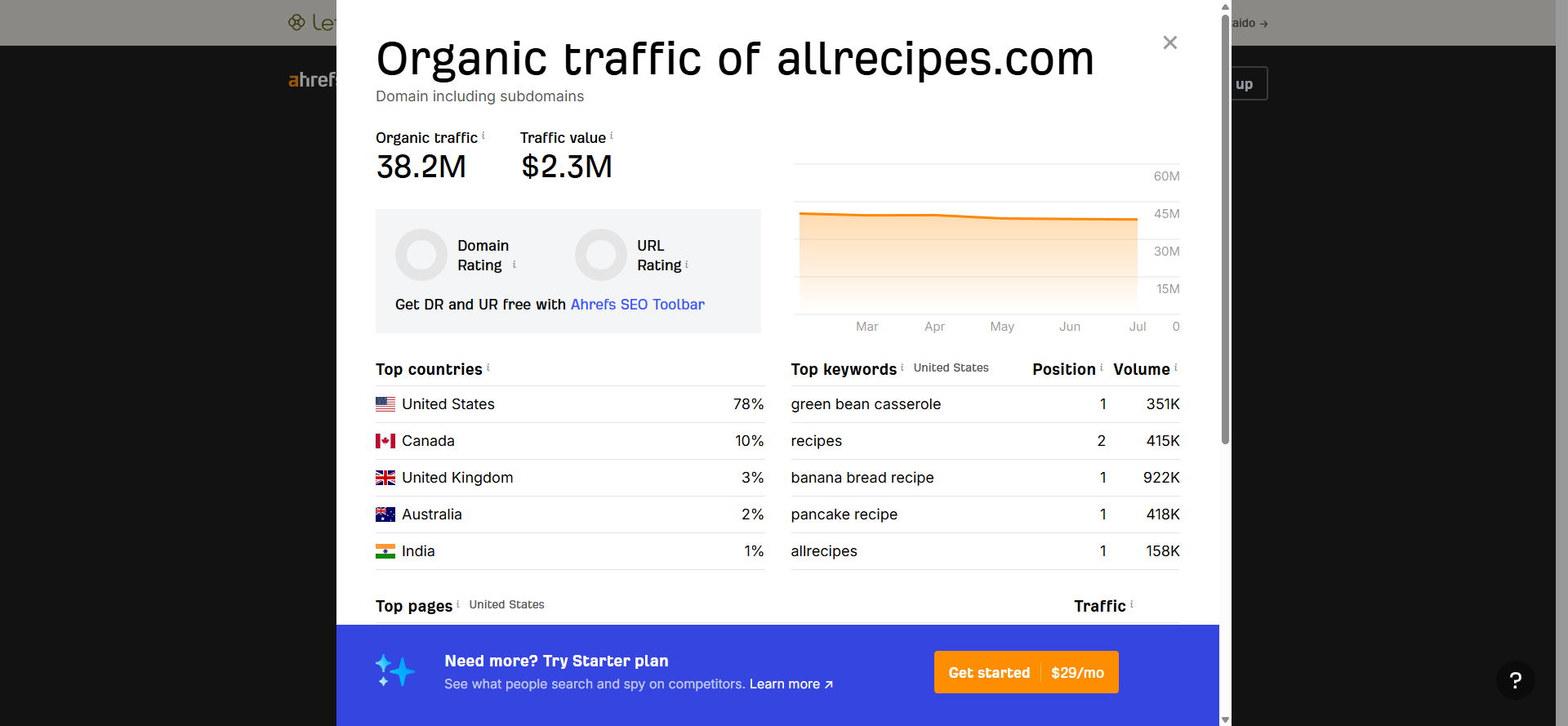
1. Ahrefs’ free Website Traffic Checker
ahrefs.com/traffic-checker — no account, no login, no card. Enter any domain and you get an estimated organic traffic figure, an estimated traffic value in dollars, the top pages driving that traffic, and the keywords the site currently ranks for, with their positions and search volumes.
It works on any domain, which means you can point it at a competitor as easily as at yourself.
2. Semrush’s free account
semrush.com — a free account gives you a limited number of lookups per day. Go to Domain Overview → Organic Research → Positions and you get a deeper ranked-keyword list than the Ahrefs free tool: position, search volume, the URL doing the ranking, and traffic share for each term.
The daily cap is real, so use your lookups deliberately: your own domain, then two or three genuine competitors.
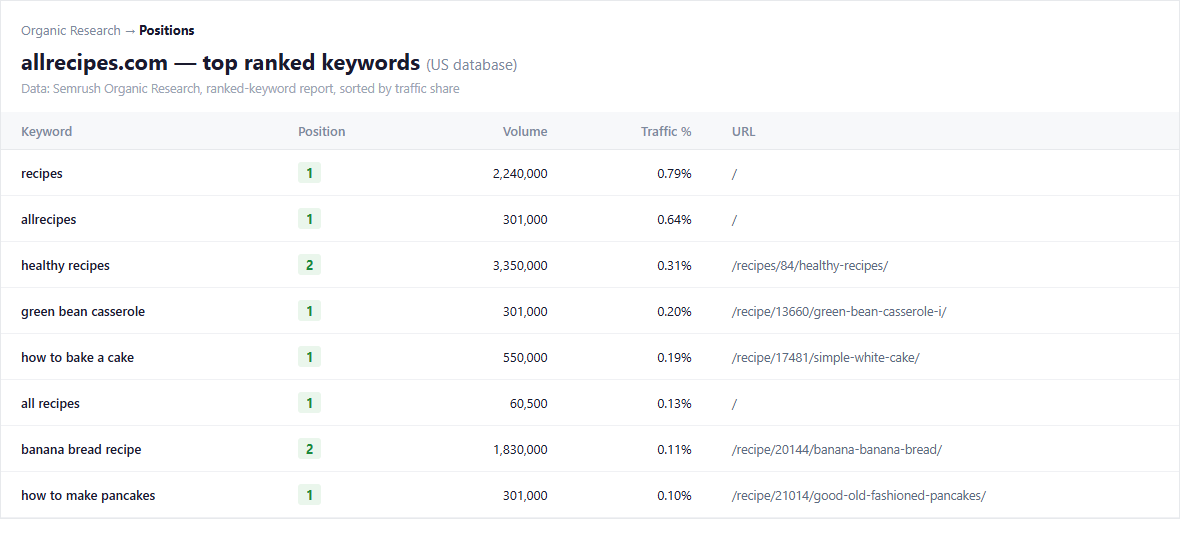
Worth knowing: if you have verified ownership of the site, Google Search Console is the definitive free source — it reports every query your pages actually receive impressions for, straight from Google. It is more accurate than any third-party estimate. Its limitation is that it only works on sites you own, which is why the two tools above are what you use for competitor research.
What to do with the list
Sort by position and look for keywords sitting between 5 and 20 with meaningful search volume behind them. Those pages are already trusted. They are the ones where a small number of strong links pays back fastest. A page at position 60 needs a content problem solved, not a link.
The four types of paid link
Editorial / contextual links. Your link placed inside genuinely relevant content on a live site. The most valuable category and the one to prioritise.
Guest posts. You (or the provider) write an article for another site, and your link sits naturally inside it. Value depends entirely on whether the host site has real readers. A guest post on a site nobody visits is a guest post on a site nobody visits.
Niche edits (link insertions). Your link is added into an existing, already-indexed article. Fast, and often effective, provided the article is actually about something adjacent to your topic. When the insertion is obviously bolted on, it is worth very little.
Digital PR. Getting cited in news coverage, industry roundups, expert commentary. The most expensive route and the strongest — because these links are the ones the other three categories are trying to imitate.
The Rankers Kiosk vetting standard
This is what we require of a domain before we will place a client link on it. We publish it because you should be holding any provider — us included — to something like it.
1. Verified organic traffic. The site must have demonstrable organic search traffic, and it must be stable or growing. A domain whose traffic has fallen off a cliff in the last quarter is a domain Google is in the middle of reassessing. We don’t want your link caught in that.
2. Content that a human would read. We look at recent posts on the target site. If the content is thin, auto-generated, or reads like it was produced solely to have somewhere to put links, we don’t place. A site that isn’t serving readers isn’t holding Google’s trust either.
3. Sane outbound linking. Healthy sites link out to relevant, authoritative sources — sometimes. Sites that link out to five unrelated industries in every article are advertising exactly what they are. We check the outbound pattern before, not after.
4. Topical relevance. Your link should sit in a place where a reader in your niche would plausibly find it. Relevance is the cheapest quality signal available and the one most bulk providers ignore entirely.
If a domain fails any of the four, it doesn’t get used. That is the whole standard — no secret sauce, just the discipline to say no to placements that are easy to sell.
How to evaluate a link before you pay for it
Run every prospective placement through this. It takes about ten minutes and it is the difference between an investment and a donation.
Real organic traffic. Not Domain Authority. Not Domain Rating. Traffic. A DR 20 site with 4,000 real monthly visitors is a better host than a DR 65 site with none — because the DR 65 site with no traffic has almost certainly bought its way there. Check the trend, not just the number.
Relevance. Would a reader of that site have any reason to click your link? If the answer requires explanation, the answer is no.
Placement. In-body, inside a paragraph, surrounded by text about the same subject. Not the footer. Not the sidebar. Not a bio. Not a “resources” list of forty outbound links.
Outbound link behaviour. Open three or four recent articles on the site. Where do the links go? If everything links to everything, nothing on that site means much.
Spam signals. Ad-choked layouts, obviously spun content, thin pages, a site that feels off. If it feels low-quality to you, assume it looks low-quality to Google. Your instinct is a better tool than most people give it credit for.
The five-question checklist
- Does this site have genuine, stable organic traffic?
- Is it recognisably relevant to my niche?
- Will my link appear inside real editorial content?
- Does the site link out selectively, or indiscriminately?
- Would I be comfortable if a real person clicked this link?
Five yeses, proceed. Anything less, walk.
Anchor text: the fastest way to give yourself away
Anchor text is one of the strongest relevance signals attached to a link — and the single most common way bought links announce themselves.
Branded anchors use your name (“Rankers Kiosk”). Safe, natural, and what real editorial links overwhelmingly look like.
Partial-match anchors wrap a keyword in natural language (“this guide to buying SEO backlinks”). Relevance without the fingerprint.
Generic anchors (“here”, “this article”, a bare URL). Low SEO value on their own, high value for making a profile look like a profile.
Exact-match anchors are the keyword and nothing else. They are the strongest signal and the most dangerous one. A page whose backlink profile is stuffed with the exact phrase it wants to rank for is describing its own strategy in public.
A distribution that stays out of trouble looks roughly like: branded 40–50%, partial-match 20–30%, generic/URL 20–30%, exact-match kept deliberately small. These are not rules handed down by Google. They are what natural profiles tend to look like, which is the point.
What SEO backlinks actually cost
| Link type | Typical range |
|---|---|
| Editorial / contextual placement on a niche site | $150 – $1,000+ |
| Guest post with content included | $200 – $600 |
| Bulk / mixed link packages | $99 – $299 |
| Digital PR feature | $500 – $2,000+ |
| Named industry / thought-leader placement | $1,000+ |
What you are paying for is not the link. It is access, editorial effort, and the time of someone who has already done the vetting. Good sites do not link out for free — particularly in competitive niches — which is why the price of a placement tracks the difficulty of getting it.
The pricing warning that matters: any offer of hundreds or thousands of links for a two-figure sum is selling volume, and volume is the one thing that stopped working. If a package promises more links than a human could plausibly place, a human didn’t place them.
Before you pay anyone, ask for: example placements, the host site’s traffic figures, and a clear statement of relevance. A provider who won’t show you those is telling you something.
Where buyers actually get burned
Almost nobody is undone by a single bad link. They are undone by patterns.
- Velocity. Two hundred links in a fortnight to a site that had eleven. Nothing in nature does that.
- Anchor repetition. The same exact-match phrase, over and over, across unrelated domains.
- Irrelevance at scale. Links from every vertical at once — the signature of a network, not an audience.
- Sites built to sell links. No real readers, no editorial standards, hundreds of outbound links to unrelated businesses. Google identified this pattern years ago.
Avoiding all four is not complicated. Buy fewer links. Buy relevant ones. Vary your anchors. Space them out. Do not buy from anyone who guarantees a ranking, because nobody can.
Three things people still get wrong
“All paid links get penalised.” Most don’t get penalised — they get ignored, which costs you the money without the drama. The outcome you’re actually protecting against is waste.
“More links is better.” A hundred irrelevant links will underperform five relevant ones, and they leave a footprint the five don’t.
“High DA is all that matters.” DA and DR are third-party scores, not Google metrics, and both can be gamed. Traffic and relevance can’t be, not easily. Judge on those.
Where Rankers Kiosk fits
We sell link placements, so treat this section with the scepticism it deserves and check us against the standard above.
What we offer is a catalogue you can scale into deliberately rather than a single package you either take or leave — smaller sets for testing and diversity, guest post placements with content included, and premium editorial placements for competitive niches. Every domain we use has to clear the four-point standard in this article before your link goes on it.
If you want an ongoing programme rather than one-off purchases, our Monthly SEO Packages run placements on a recurring cadence, which is generally how you want links arriving anyway — steadily, not in a burst.
Otherwise, browse the shop and pick what fits the pages you identified in the free-tools step above.
Frequently asked questions
Is buying SEO backlinks against Google’s rules?
Buying links that pass ranking credit without a sponsored or nofollow attribute is, by Google’s own published spam policy, link spam. Google also says paid links are fine when properly attributed. Anyone who tells you a purchased dofollow link is explicitly permitted is misrepresenting the policy. What we can tell you honestly is that the consequence for a small number of relevant, well-placed links on real sites is, in practice, very different from the consequence for thousands of automated placements — and that the far more common failure mode is not a penalty but a link that simply doesn’t count.
How many backlinks do I need to reach page one?
There is no number, and anyone quoting one is guessing. It depends entirely on the competition for that specific keyword and what your competitors’ pages already have. Use the free tools above to look at who currently ranks, then work backwards. For a low-competition term, a handful of relevant links can be enough. For a commercial head term, it is a different game entirely.
How long until I see movement?
Placements typically go live within a couple of weeks. Ranking effects take longer — usually one to three months, assuming the link is counted at all and your on-page work is sound. Anyone promising results in days is selling something other than SEO.
Should I buy links for a brand-new site?
Cautiously, if at all. A new domain with no history acquiring paid links quickly is the easiest pattern in the world to spot. Build some content, get some baseline traffic, then start slowly and relevantly.
Sources: Backlinko, We Analyzed 11.8 Million Google Search Results (backlinks and ranking correlation, 3.8×); Ahrefs, analysis of 1B+ pages (66.31% of pages have zero referring domains); Ahrefs Content Explorer (~2.2% of content earns links from multiple sites); Google Search Central, Spam Policies for Google Web Search (link spam definition; rel=”sponsored” / rel=”nofollow” qualification); Google Search Console Help, Manual actions report (unnatural links manual actions).